Author Archives: ipnews

GW Micro, Inc. Announces SocialEyes

Fort Wayne, Indiana (July 3, 2013) - GW Micro, Inc. (www.gwmicro.com) is proud to announce SocialEyes, an application for Windows-based PCs that provides access to Facebook via a consistent, keyboard-friendly, and fully-accessible user interface.

While Facebook is committed to enhancing the accessibility of the Facebook website, screen reader users often find navigating the default interface overwhelming and cumbersome. Using standard and common controls, SocialEyes brings a fresh, streamlined and easy to use interface to the Facebook social networking platform.

SocialEyes offers Facebook users the ability to access their newsfeed, read comments, create comments, like posts, search for events, pages, friends, groups, and more.

Users can also read notifications, messages, chat with their friends, write on timelines, manage friend requests, and access event information. SocialEyes even has the ability to attach links, photos, or video to status updates.

SocialEyes also provides additional features, such as custom notification sounds, and message filtering, all designed to help you stay in touch with all of your Facebook friends.

SocialEyes is compatible with Window-Eyes and other popular screen readers. Low vision users may also benefit from SocialEyes by using it with a screen magnifier, such as ZoomText.
A SocialEyes annual subscription can be purchased for $50, but for a limited time, you can get an annual subscription for only $25. SocialEyes will be made available for purchase soon, and pre-orders are now being accepted by GW Micro. You can pre-order SocialEyes today by calling GW Micro at (260) 489-3671.

To learn more about SocialEyes, please check out the Introduction to SocialEyes video tutorial. The video can be accessed from GW Micro’s YouTube channel:
http://youtu.be/ULm6DW4zAmw
and can also be downloaded from the GW Micro website:
www.gwmicro.com/Training/Tutorials/Video/SocialEyes_Intro.mp4
A text transcript is also available at:
www.gwmicro.com/Training/Tutorials/Text/SocialEyes_Intro.txt
.
Contact:
Dan Weirich
GW Micro, Inc.
725 Airport North Office Park
Fort Wayne, IN 46825
Email: [email protected]
Web: www.gwmicro.com

Project CARAT Recycles and Refurbishes Medical Equipment in Eastern Kentucky

reveal-logo

Many people in the Appalachian region of Kentucky have little or no access to health insurance to assist in paying for medical equipment like walkers, wheelchairs, canes, or crutches. A group of faculty and students at the University of Kentucky College of Health Sciences are taking part in a project to bring in used medical equipment, clean and repair it, and distribute it to the people who need it.

This project, Coordinating and Assisting the Reuse of Assistive Technology (CARAT), began in May 2012 with a $450,000, three-year grant from the U.S. Department of Health & Human Services.

“Assistive Technology recycling is done across the United States and Medicaid equipment recycling is done in a few places, but nowhere are they using this service-learning type of model that we are using here in Kentucky,” said Carol Weber, project coordinator for CARAT in the Kentucky Office of Vocational Rehabilitation.

CARAT partners include the Kentucky Office of Vocational Rehabilitation, the Kentucky Appalachian Rural Rehabilitation Network (KARRN) based at UK, and the Bluegrass Technology Center.

KARRN is an NIH-funded project to support people in Eastern Kentucky returning home after stroke, brain or spinal cord injuries and is a partner of the Center for Excellence in Rural Health in Hazard.

The Center for Excellence in Rural Health in Hazard is serving as the Southeast refurbishing site for CARAT and physical therapy students there manage the Hazard part of the program, said Patrick Kitzman, associate professor in the UK Physical Therapy and Rehabilitation Sciences Doctoral Program. “This project gives the students a great opportunity for gaining leadership skills in running a part of this project, gaining experience in refurbishing durable medical equipment, and providing a service to their community,” he said.

Two of those physical therapy students, Devon Burchett and Jessica Bickwermert, are excited to give back and get hands-on training that will help them in their careers.

“We’ve brought in used equipment, we have cleaned them, we’ve replaced parts. I come from rural town so it feels good to be able to give back to those who have provided for me. It just feels good to know that we are helping to improve someone’s quality of life,” said Burchett.

“We’re going to know how to fix the equipment ourselves if problems arise while we’re with patients,” Bickwermert added. “Dr. Kitzman’s already told us about things that he’s gone through as a physical therapist himself and how he’s had to make those minor adjustments.”

CARAT’s database of no-cost or low-cost refurbished items, including walkers, wheelchairs, scooters, canes, quad canes, crutches, and hospital beds, can be accessed at katsnet.at4all.com.

Kentucky Office of Vocational Rehabilitation
Kentucky Appalachian Rural Rehabilitation Network (KARRN)
Kentucky Assistive Technology Services (KATS) Network
Bluegrass Technology Center (BTC)

To donate home medical equipment, visit BTC at www.bluegrass-tech.org or call 859-294-4343.

Public Notice

fcc-logo

BUREAU ANNOUNCES 2013-2014 STATE ALLOCATIONS FOR THE NATIONAL DEAF-BLIND EQUIPMENT DISTRIBUTION PROGRAM

Washington, D.C. – The Consumer and Governmental Affairs Bureau (CGB) of the Federal Communications Commission (FCC) announces the state funding allocations for the National Deaf-Blind Equipment Distribution Program (NDBEDP) for the 2013-2014 Fund year.

The NDBEDP is a program mandated by section 105 of the Twenty-First Century Communications and Video Accessibility Act (CVAA) that provides funding of up to $10 million annually for the distribution of communications equipment to low-income individuals who are deaf-blind.[1] On April 4, 2011, the Commission adopted the NDBEDP Pilot Order, establishing the framework for a pilot program to fulfill this CVAA mandate.[2] In that Order, the Commission determined that it would certify one entity per state as eligible to receive support for the local distribution of equipment to low-income individuals who are deaf-blind.[3] On July 2, 2012, after an application and selection process, the Commission announced the entities that had been selected as certified programs to participate in the NDBEDP and informed them of the respective state allocations for the 2012-2013 Fund year.[4]

For each year of the pilot program, the Commission sets aside $500,000 of the $10 million (annually allocated for the NDBEDP) for national outreach efforts.[5] The remaining $9.5 million of annual funding is used to reimburse NDBEDP certified programs for the reasonable costs of operating their programs in compliance with the Commission’s NDBEDP rules.[6] Funding allocations for the 2012-2013 Fund year were calculated by allocating a minimum base amount of $50,000 for each jurisdiction plus a portion of the remaining available funding in an amount proportionate to the population of each jurisdiction.[1] Allocations for the 2013-2014 Fund year were calculated by using the same formula with the most current census population estimates and appear below:[2]

State

NDBEDP Certified Program

Funding Allocation

for 2013-2014

Alabama Alabama Institute for the Deaf and Blind

$153,973

Alaska Assistive Technology of Alaska

$65,772

Arizona Perkins School for the Blind

$191,302

Arkansas Perkins School for the Blind

$113,589

California Lighthouse for the Blind and Visually Impaired

$870,252

Colorado Colorado Commission for the Deaf and Hard of Hearing

$161,855

Connecticut Connecticut Tech Act Project

$127,415

Delaware University of Delaware – Center For Disabilities Studies

$69,774

Florida Florida Telecommunications Relay, Inc.

$466,527

Georgia Georgia Council for the Hearing Impaired

$263,895

Hawaii Island Skill Gathering

$80,021

Idaho University of Idaho – Idaho Assistive Technology Project

$84,407

Illinois The Chicago Lighthouse for People Who Are Blind or Visually Impaired

$327,617

Indiana Indiana State University

$190,958

Iowa Iowa Utilities Board

$116,286

Kansas Assistive Technology for Kansans

$112,226

Kentucky Eastern Kentucky University Center on Deafness and Hearing Loss

$144,451

Louisiana Affiliated Blind of Louisiana Training Center

$149,226

Maine Maine Center on Deafness

$78,660

Maryland Perkins School for the Blind

$176,883

Massachusetts Perkins School for the Blind

$193,305

Michigan Michigan Commission for the Blind

$263,106

Minnesota Minnesota Department of Human Services Deaf and Hard of Hearing Service Division

$165,985

Mississippi The Arc of Mississippi

$114,361

Missouri Missouri Assistive Technology

$179,847

Montana Perkins School for the Blind

$71,673

Nebraska Nebraska Commission for the Deaf and Hard of Hearing

$90,009

Nevada To Be Determined

$109,488

New Hampshire Northeast Deaf and Hard of Hearing Services, Inc.

$78,477

State

NDBEDP Certified Program

Funding Allocation

for 2013-2014

New Jersey New Jersey Commission for the Blind and Visually Impaired

$241,139

New Mexico Perkins School for the Blind

$94,969

New York Helen Keller National Center for Deaf-Blind Youth and Adults

$471,975

North Carolina North Carolina Division of Services for the Deaf and the Hard of Hearing

$260,275

North Dakota Interagency Program for Assistive Technology

$65,085

Ohio Ohio Deaf-Blind Outreach Program

$298,917

Oklahoma Oklahoma Department of Rehabilitation Services

$132,255

Oregon Access Technologies, Inc.

$134,078

Pennsylvania Institute on Disabilities – Temple University

$325,208

Rhode Island Perkins School for the Blind

$72,646

South Carolina Perkins School for the Blind

$151,853

South Dakota South Dakota Department of Human Services

$67,969

Tennessee Tennessee Regulatory Authority

$189,210

Texas Perkins School for the Blind

$611,890

Utah Utah Public Service Commission

$111,566

Vermont Vermont Center for the Deaf and Hard of Hearing

$63,498

Virginia Virginia Department for the Deaf and Hard of Hearing

$226,504

Washington Department of Social and Health Services – Office of the Deaf and Hard of Hearing

$198,714

West Virginia Perkins School for the Blind

$90,007

Wisconsin Public Service Commission of Wisconsin

$173,473

Wyoming Wyoming Institute for Disabilities – University of Wyoming

$62,429

Washington, DC Columbia Lighthouse for the Blind

$63,634

Puerto Rico Perkins School for the Blind

$129,070

U.S. Virgin Islands Perkins School for the Blind

$52,294

ACCESSIBLE FORMATS: To request materials in accessible formats for people with disabilities (Braille, large print, electronic files, audio format), send an e-mail to [email protected] or call the Consumer and Governmental Affairs Bureau at 202-418-0530 (voice), 202-418-0432 (TTY).

FOR FURTHER INFORMATION CONTACT: Jackie Ellington, Consumer and Governmental Affairs Bureau, 202-418-1153, e-mail [email protected]; or Rosaline Crawford, Consumer and Governmental Affairs Bureau, 202-418-2075, e-mail [email protected].


Disabled workers paid just pennies an hour – and it’s legal

Critics cry exploitation as a federal loophole allows companies to pay thousands of disabled workers across the country far less than the minimum wage. Harry Smith’s full report airs Friday, June 21 at 10pm/9CDT on NBC’s Rock Center with Brian Williams.

By Anna Schecter, Producer, NBC News

One of the nation’s best-known charities is paying disabled workers as little as 22 cents an hour, thanks to a 75-year-old legal loophole that critics say needs to be closed.

Goodwill Industries, a multibillion-dollar company whose executives make six-figure salaries, is among the nonprofit groups permitted to pay thousands of disabled workers far less than minimum wage because of a federal law known as Section 14 (c). Labor Department records show that some Goodwill workers in Pennsylvania earned wages as low as 22, 38 and 41 cents per hour in 2011.

“If they really do pay the CEO of Goodwill three-quarters of a million dollars, they certainly can pay me more than they’re paying,” said Harold Leigland, who is legally blind and hangs clothes at a Goodwill in Great Falls, Montana for less than minimum wage.

“It’s a question of civil rights,” added his wife, Sheila, blind from birth, who quit her job at the same Goodwill store when her already low wage was cut further. “I feel like a second-class citizen. And I hate it.”

Section 14 (c) of the Fair Labor Standards Act, which was passed in 1938, allows employers to obtain special minimum wage certificates from the Department of Labor. The certificates give employers the right to pay disabled workers according to their abilities, with no bottom limit to the wage.

Most, but not all, special wage certificates are held by nonprofit organizations like Goodwill that then set up their own so-called “sheltered workshops” for disabled employees, where employees typically perform manual tasks like hanging clothes.

For more on disabled workers and sub-minimum-wage pay watch ‘Rock Center’ tonight.

The non-profit certificate holders can also place employees in outside, for-profit workplaces including restaurants, retail stores, hospitals and even Internal Revenue Service centers. Between the sheltered workshops and the outside businesses, more than 216,000 workers are eligible to earn less than minimum wage because of Section 14 (c), though many end up earning the full federal minimum wage of $7.25.
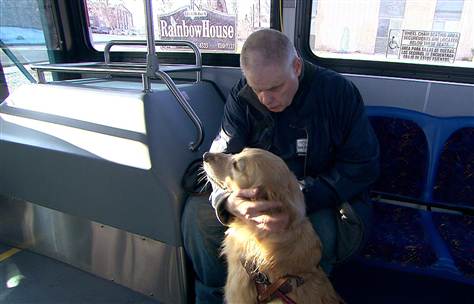
Harold Leigland and his service dog on the bus on the way to work.

Harold Leigland, who is blind, with his guide dog on the bus during his morning commute to the Goodwill facility in Great Falls, Montana, where he works hanging clothing.

When a non-profit provides Section 14 (c) workers to an outside business, it sets the salary and pays the wages. For example, the Helen Keller National Center, a New York school for the blind and deaf, has a special wage certificate and has placed students in a Westbury, N.Y., Applebee’s franchise. The employees’ pay ranged from $3.97 per hour to $5.96 per hour in 2010. The franchise told NBC News it has also hired workers at minimum wage from Helen Keller. A spokesperson for Applebee’s declined to comment on Section 14 (c).

Helen Keller also placed several students at a Barnes & Noble bookstore in Manhasset, N.Y., in 2010, where they earned $3.80 and $4.85 an hour. A Barnes & Noble spokeswoman defended the Section 14 (c) program as providing jobs to “people who would otherwise not have [the opportunity to work].”

Most Section 14 (c) workers are employed directly by nonprofits. In 2001, the most recent year for which numbers are available, the GAO estimated that more than 90 percent of Section 14 (c) workers were employed at nonprofit work centers.

Critics of Section 14 (c) have focused much of their ire on the nonprofits, where wages can be just pennies an hour even as some of the groups receive funding from the government. At one workplace in Florida run by a nonprofit, some employees earned one cent per hour in 2011.

“People are profiting from exploiting disabled workers,” said Ari Ne’eman, president of the Autistic Self Advocacy Network. “It is clearly and unquestionably exploitation.”

Defenders of Section 14 (c) say that without it, disabled workers would have few options. A Department of Labor spokesperson said in a statement to NBC News that Section 14 (c) “provides workers with disabilities the opportunity to be given meaningful work and receive an income.”

Terry Farmer, CEO of ACCSES, a trade group that calls itself the “voice of disability service providers,” said scrapping the provision could “force [disabled workers] to stay at home,” enter rehabilitation, “or otherwise engage in unproductive and unsatisfactory activities.”

Harold Leigland, however, said he feels that Goodwill can pay him a low wage because the company knows he has few other places to go. “We are trapped,” he said. “Everybody who works at Goodwill is trapped.”

Leigland, a 66-year-old former massage therapist with a college degree, currently earns $5.46 per hour in Great Falls.

His wages have risen and fallen based on “time studies,” the method nonprofits use to calculate the salaries of Section 14 (c) workers. Staff members use a stopwatch to determine how long it takes a disabled worker to complete a task. That time is compared with how long it would take a person without a disability to do the same task. The nonprofit then uses a formula to calculate a salary, which may be equal to or less than minimum wage. The tests are repeated every six months.
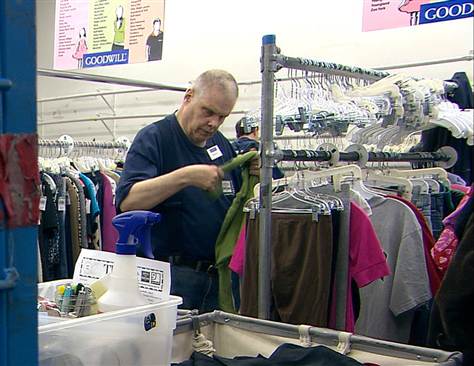
Harold Leigland works at the Goodwill facility in Great Falls, Montana, where he earns $5.46 an hour.

Harold Leigland works at the Goodwill facility in Great Falls, Montana, where he earns $5.46 an hour.

Leigland’s pay has been higher than $5.46, but it has also dropped down to $4.37 per hour, based on the time-study results.
He said he believes Goodwill makes the time studies harder when they want his wage to be lower.

“Sometimes the test is easier than others. It depends on if, as near as I can figure, they want your wage to go up or down. It’s that simple,” he said.

His wife, Sheila, 58, spent four years hanging clothes at the Great Falls Goodwill for about $3.50 an hour. She said the time study was one of the most degrading and stressful parts about her job. “You never know how it’s going to come out. It stressed me out a lot,” she said.

She quit last summer when she returned to work after knee surgery and found that her wage had been lowered to $2.75 per hour, a training rate.

“At $2.75 it would barely cover my cost of getting to work. I wouldn’t make any money,” she said.

Harold said he believes Goodwill can afford to pay him minimum wage, based on the salaries paid to Goodwill executives. While according to the company’s own figures about 4,000 of the 30,000 disabled workers Goodwill employs at 69 franchises are currently paid below minimum wage, salaries for the CEOs of those franchises that hold special minimum wage certificates totaled almost $20 million in 2011.

In 2011 the CEO of Goodwill Industries of Southern California took home $1.1 million in salary and deferred compensation. His counterpart in Portland, Oregon, made more than $500,000. Salaries for CEOs of the roughly 150 Goodwill franchises across America total more than $30 million.

Goodwill International CEO Jim Gibbons, who was awarded $729,000 in salary and deferred compensation in 2011, defended the executive pay.

“These leaders are having a great impact in terms of new solutions, in terms of innovation, and in terms of job creation,” he said.

Gibbons also defended time studies, and the whole Section 14 (c) approach. He said that for many people who make less than minimum wage, the experience of work is more important than the pay.

“It’s typically not about their livelihood. It’s about their fulfillment. It’s about being a part of something. And it’s probably a small part of their overall program,” he said.

Read Goodwill’s full statement

And Goodwill and the organizations that run the sheltered workshops are not alone in their support for Section 14 (c). In many cases, the families of the workers who have severe disabilities say their loved ones enjoy the work experience, enjoy getting a paycheck, and the amount is of no consequence.
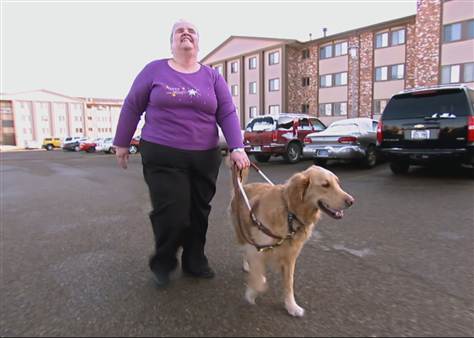
Sheila Leigland, who is blind, with her guide dog. She quit her job at Goodwill in Great Falls, Montana, after her hourly wage was lowered to $2.75.

Sheila Leigland, who is blind, with her guide dog. She quit her job at Goodwill in Great Falls, Montana, after her hourly wage was lowered to $2.75.


“I feel really good about it. I don’t have to worry so much about him,” said Fran Davidson, whose son Jeremy has worked at Goodwill in Great Falls, Montana, for more than a decade. “I know he’s not getting picked on, and he’s in a safe place. He enjoys what he’s doing, and he’s happy, and that’s what we like for our kids.” Jeremy started out working for a sub-minimum wage but did well on his last time study and is currently earning $7.80 an hour, Montana’s minimum wage.

But foes of Section 14 (c) have hopes for a new bill that’s now before Congress that would repeal Section 14 (c) and make sub-minimum wages illegal across the board.

“Meaningful work deserves fair pay,” the sponsor of the bill, Rep. Gregg Harper, R.-Miss., told NBC News. “This dated provision unjustly prohibits workers with disabilities from reaching their full potential.”

The bill is opposed by trade associations for the employers of the disabled, and past attempts to change the law have failed. But Marc Maurer, president of the National Federation of the Blind and a foe of the sheltered workshop system, is cautiously optimistic that this time the bill will pass, and end what he called a “two-tiered system.”

That system, explained Maurer, says “‘Americans who have disabilities aren’t as valuable as other people,’ and that’s wrong. These folks have value. We should recognize that value.”

Monica Alba contributed to this report.
“WE DON’T NEED TO SEE OR HEAR IN ORDER TO TOUCH THE WORLD AROUND US.”

Come Join Us…

Celebrating the National
Helen Keller Deaf-Blindness Awareness Week

When: June 26, 2013, 11 a.m.—1 p.m.
Where: Independence Place, Inc.
1093 S Broadway, Suite 1220
Lexington, Kentucky 40504

To RSVP for lunch please call
Independence Place, Inc. @ (859) 266-2807

Keynote Speaker:

Rick Roderick,

President of Kentucky Association of the Deaf Blind

• Enjoy lunch
• Learn about Independent Living Services
• Accessing information by KY NFB-NEWSLINE®

16th Annual ADA Rally 2013

16th-annual-ada-rally-2013


IPlogo72dpi.gif


One Voice~United!

Independence Place, Inc.
Presents:
The ADA Action Network of Kentucky Celebrating the 23rd Anniversary of
Americans With Disabilities Act

NO CHILD ~ NO ADULT ~ NO ONE LEFT BEHIND

Capitol Rotunda July 29, 2013
700 Capital Avenue 11:00 am to 1:00 pm
Frankfort, Kentucky Lunch is provided

“Every man, woman, and child with a disability now can pass through the once closed doors into a bright new era of freedom, independence, and equality (President George Bush, July 26, 1990).”

Join with hundreds of Kentuckians with disabilities, family members and advocates from across the Commonwealth to celebrate the 23rd anniversary of the enactment of the ADA (July 26, 1990). Come be visible, vocal, and vigilant to protect our rights! We must ensure that all programs and services are accessible to and usable by Kentuckians with disabilities.

ada-rally-us-flag


Please call for Alternative Format
Accommodations by July 14, 2013

For more information and to RSVP contact:handicap symbol
Independence Place, Inc.
1093 S. Broadway, Suite 1218
Lexington, Kentucky 40504
(859) 266-2807 or Toll Free (877) 266-2807
[email protected]

Deaf-blind see ‘stars’ at annual retreat; community provides support, technology

by Joan Kite

Both had come undone.

For days, teacher Anne Sullivan was spelling words in the hands of young deaf-blind Helen Keller, a prisoner of darkness and silence in 1887. When Anne spelled the word “c-u-p” into Helen’s palm, Helen answered by smashing the vessel into bits. Finally, in a fit of angry inspiration, Anne dragged Helen to a well, shoved her student’s tiny hand under the running water and furiously spelled the word “w-a-t-e-r.”

In one historical second, contact. Helen understood. Connection was made.

Helen Keller went on to become a renowned author, speaker, political activist, and icon for the deaf-blind community. Her efforts inspired President Ronald Reagan to declare the last week of June as National Deaf-Blind Awareness Week.

This spring, 22 deaf-blind residents gathered at an annual retreat in Nancy, Kentucky, to hold the stars in their hands.

With an iPad and the Skyview app, Marilyn Trader, a region representative for the Helen Keller National Center for Deaf-Blind Youths and Adults, told her deaf-blind audience, “We’re going to bring the stars to your hands tonight.”

Deaf-blind participants honed an iPad on the Big Dipper. The real-time stardust appeared instantly on the screen.

“Oh my goodness, it felt like I was touching Jesus tonight,” said Eubank resident Loretta Gilliand.

Gilliand and her sister, Margo Cameron, of Somerset, were born deaf and blind. Both use hearings aids and canes. The two attended the annual retreat, held every April at Lake Cumberland 4-H Recreational Center. There, counselors helped them to obtain new iPads and iPhones.

“I was trying to get me something for when I go to the grocery store or here at home to tell me what the labels on grocery food say,” Cameron said. The 48-year-old woman lives alone with her 10-year-old granddaughter. Cameron’s 18-year-old daughter was killed in a car crash seven years ago.

New technology and the caring of skilled professionals expands the world for Kentucky’s deaf-blind community. It’s a small one. Nationally, about 40,000 are deaf-blind. Kentucky’s Office of the Blind has 800 deaf-blind consumers, said Dorothy Brame, state coordinator for deaf-blind programs.

“If someone is legally blind and has a hearing impairment, that is considered as deaf-blindness, too,” Brame said.

Consumers, as they are called in the government system, can be born deaf-blind or lose sight and hearing at any age. Routinely, the elderly join the ranks of the deaf-blind due to age-related conditions or illnesses.

National organizations, like the Helen Keller National Center for Deaf-Blind Youths and Adults, and state organizations, like the Office of the Blind, the Kentucky Deaf-Blind Project, and the Kentucky Association for the Deaf-Blind, provide assistance to the deaf-blind. Most services help deaf-blind people live in the world as productive citizens– holding jobs, earning degrees, and living lives as independently as they can.

Exclusion and breaking through the isolation are huge hurdles, said Pamela Glisson, executive director of Independence Place. Located in Lexington, Independence Place caters to anyone with any kind of disability.

Glisson, who grew up blind in Harlan County, knows how difficult it is to get help and understanding. She struggled in grade and high schools, but went on to learn Braille, attend college, and earn her bachelors and masters degrees. Today, all her office equipment talks to her.

“I couldn’t do my job without assistive technology. All my devices talk – my computer, my iPhone, and my K-NFB reader,” Glisson said. She even has a device that scans a business card and reads it aloud instantly. Meeting people has never been easier.

Independence Place also offers National Federation of the Blind-Newsline, a news and information service, to those individuals who have devices with a refreshable Braille display. Increasingly, software developers are creating disabled-friendly apps like Humanware Communicator and Purple that plug into handheld devices.

“We can see that those in need get financial assistance to acquire assistive technology,” Glisson said. Grants and loans are available. iCanConnect, the national deaf-blind equipment distribution program, also provides equipment to those who qualify for the federal program.

Twyla Hammons, who serves at Somerset’s Kentucky Office of the Blind, said she would like the region to finance and install handicapped-accessible devices like chirping crosswalk signals so the disabled can find their way around town.

The first step to get help is knowing where to go. If you are reading this story, and know someone who is deaf-blind, share this information with them. You can introduce them to a new world, a new life.

Help for the Deaf-Blind

Helen Keller National Center for Deaf-Blind Youth and Adults
www.hknc.org
[email protected]
(516) 944-8900

Kentucky Association of the Deaf-Blind
President Rick Roderick
(502) 423-8195

Kentucky Office of Vocational Rehabilitation
Deaf-Blind Services
www.ovr.ky.gov
(502) 564-4440

Kentucky Office for the Blind
www.blind.ky.gov
(800) 321-6668

Kentucky Office for the Blind (Somerset)
(606) 677-4042

Independence Place
www.independenceplaceky.org
(877) 266-2807
[email protected]

Fair Wages Petition

As you know, the National Federation of the Blind is leading the effort to stop the exploitation of workers with disabilities who receive subminimum wages. Written in 1938, Section 14(c) of the Fair Labor Standards Act (FLSA) discriminates against people with disabilities by allowing the secretary of labor to grant Special Wage Certificates to employers, permitting them to pay workers with disabilities less than the minimum wage. Despite enlightened civil rights legislation prohibiting discrimination on the basis of disability, this antiquated provision is still in force, with some disabled workers making only three cents an hour.

Please help support our efforts to stop this exploitation by signing the online petition calling for fair wages for workers with disabilities. You can sign the petition at http://www.nfb.org/fair-wages-petition.

Once you have signed the petition, be sure to share it with friends, family, and fellow Federationists. If you’re an affiliate or chapter leader, please encourage all of your members and supporters to sign the petition. Just pass along the link: http://www.nfb.org/fair-wages-petition.

You can also ask your Facebook friends and Twitter followers to sign the petition by posting or tweeting the link: http://www.nfb.org/fair-wages-petition.

This petition is an important way to show the disability community, members of Congress, and the general public how important this issue is to us. You can add your voice to the growing chorus of support for fair wages in less than a minute. Just visit this link, or paste it into your browser, and sign the petition: http://www.nfb.org/fair-wages-petition.

Please sign the petition and pass on the link right away. Thanks for helping in this critically important effort.

Sincerely,
Chris Danielsen
Director of Public Relations
National Federation of the Blind